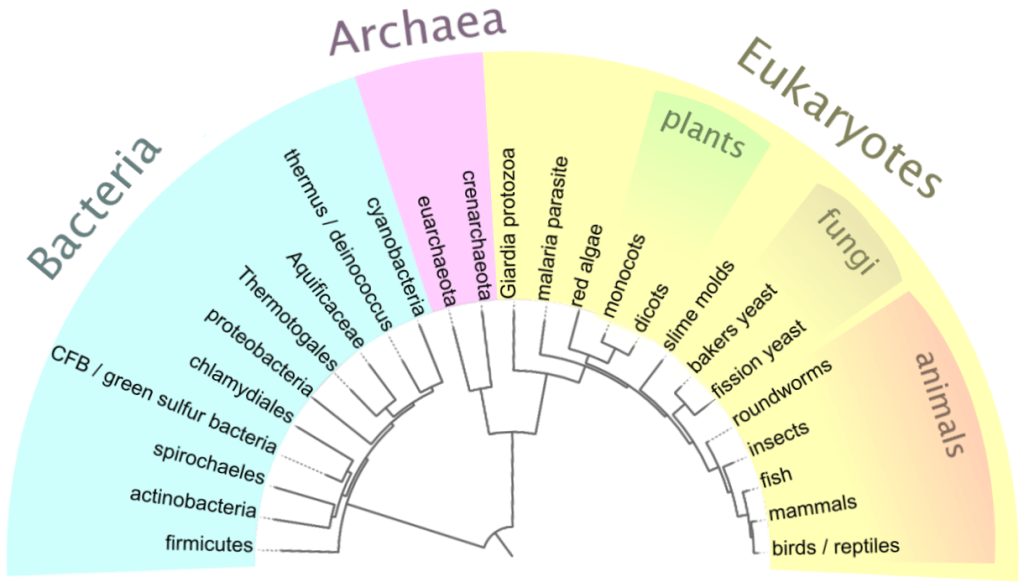
There is perhaps no question that has plagued virologists and evolutionary biologists more than this: where do viruses come from? Frustratingly, the tools that we traditionally use to infer evolutionary history, struggle to place viruses in the Tree of Life1. Even more perplexing is that we have yet to identify a universal common ancestor for viruses, and, in fact, it appears that each viral group may have its own evolutionary origin.
In practice, scientists often look at shared genes to determine evolutionary relationships. When we apply this approach to viruses, we can see that there are some viral genes that look a lot like cellular genes, which often bear similarity to the genes of the viruses host or are shared amongst several viral groups and can be used to infer the relative relatedness of viral groups2. For example, some RNA virus groups share a very similar enzyme that does not appear in other viral groups, allowing us to say that they are probably descended from a single shared origin1. We can even use these approaches to figure out which viruses are ancestral and which have emerged more recently. However, there are also many, many genes that scientists cleverly call ORFans (haha get it, orphans?) that are not found anywhere in cellular life1. This makes it incredibly difficult to use traditional phylogenetic analyses to determine the origins of viral groups and has led to the three theories that are laid out here 3.
What is clear is that viruses, which we will broadly define here as molecular genetic parasites4, are probably extremely ancient and perhaps even pre-date the first cell. Considering the critical ecological role that viruses play in every single ecosystem on Earth5, it would be of great interest to know where these mysterious entities lie in the biological history of our planet. What’s more, viruses probably played crucial roles in the evolution of life, including the evolution of the eukaryotic nucleus4. The sheer genetic diversity encoded by viruses alone suggests that they may have played (and continue to play) a key role in shaping global biological diversity. Although it would probably take an entire book to outline all the extant theories regarding the “true” origin of viruses, I will spare you the nitty gritty details and highlight three of the leading theories, though I caution that no single one is universally accepted by the scientific community. I leave it up to you to decide which camp you fall into.
Theory #1: Viruses as the original gangsters (OGs) of Earth – “virus-first hypothesis”
Ok, let’s start by imaging what Earth looked like way back when. We don’t know precisely when the first virus would have evolved, but Earth was probably not a very nice place to live 3-4 billion years ago. There was limited oxygen, and the sun’s rays were irradiating Earth’s surface with no ozone layer to attenuate them 6. Astounding as it is to imagine, there were no plants, no bacteria, no cells, and presumably no DNA. In this world, the only nucleic acid available was probably ribonucleic acid (RNA), a simpler, single-stranded alternative to deoxyribonucleic acid (DNA). Hence, researchers refer to this world as the RNA world7. In this RNA world, RNA molecules capable not only of storing genetic information but also of replicating themselves were prevalent8. Some authors argue that in this primordial RNA world, interactions between various molecular elements under just the right biochemical conditions catalyzed the emergence of major viral groups, including the ones that we routinely encounter today such as the double-stranded RNA (dsRNA) viruses, double-stranded DNA (dsDNA) viruses, and others1. Though this theory has been circulating for nearly 100 years, a principal issue that it struggles to explain is that all viruses that exist today are intimately dependent on their host for survival. So how is it possible that viruses could evolve before their cellular hosts? The key is first to understand that at its most basic level, a virus is simply a replicating element that relies on another replicating element to supply the proteins needed for reproduction. Under this basic framework, it is plausible that co-circulating replicating elements could parasitize one another, with those “stealing” replication machinery from others gaining a fitness advantage. Over time (billions of years) this could evolve into the classic view of viruses that we have today, particularly the more genetically concise RNA viruses.
Theory #2: Viruses as prison escapees – “escape hypothesis”
An alternative to the “virus-first hypothesis” postulates that mobile genetic elements, or genes that can hop around in the host genome, somehow figured out how to exit the host cell. This is exactly what retroviruses like human immunodeficiency virus (HIV) or Rouse sarcoma virus (RSV) do when they infect cells. Upon entry into the cell, the single-stranded RNA genome is converted into double-stranded DNA and wedges itself into the host genome thanks to the aptly named integrase enzyme. Once comfortably situated inside of the host genome, the virus can safely copy its genome back into single stranded RNA form using the hosts’ own enzymes and can translate all of the structural proteins required to safely transport the copied genome to a new cell9. Interestingly, there are non-viral genetic elements called retrotransposons that do something very similar, suggesting that this gene escape could have led to the evolution of at least some viral groups3. This theory has since been adapted and diverged into two related ideas. The first suggests that viruses emerged as escapees from eukaryotic and prokaryotic cells, explaining the lack of similarities between viruses of eukaryotes (think things like humans, plants, insects, fungi, etc.) and the phage viruses of the prokaryotes (namely, bacteria). The second proposes that viruses may have escaped from ancient cellular structures called ribocells3,10.
Theory #3: Viruses as very lazy cells – “reduction/regression hypothesis”
And finally, the most recently proposed of the big three hypotheses, supposes that viruses evolved as formerly fully functional cells gradually lost the ability to synthesize some of their own proteins11. If the loss of these proteins provided a fitness advantage to the cells, perhaps by streamlining their replication rate or minimizing expanded energy, then it is easy to see how viruses could have emerged over time. For evidence of this, we can turn to members of the nucleocytoplasmic large DNA virus (NCLDVs). As their name suggests, NCLDVs are large enough to dwarf some bacteria with genomes on the order of megabases not kilobases. What makes these NCLDVs so special (besides the fact that they’re just really cool), is that they encode an astounding diversity of proteins with complex functions, many of which share structural and sequence similarity with proteins of their hosts12. For a long time, the dogma has been the viruses inevitably need their hosts because they rely on host protein for translation. As a brief reminder, translation is the process by which messenger RNA is converted into proteins which then go on to catalyze reactions, replicate genomes, and interfere with immune responses, among other things. However, recent publications in Cell13 and Nature14 have demonstrated that contrary to popular belief, viruses can actually encode their own translation-initiation complexes and ribosomal proteins, both key components of translation! Unfortunately, just knowing that genes bearing structural and sequence similarity are encoded in host and viral genomes is not enough to tell us which one came first, but it is still a fascinating discovery that could suggest that viruses were once fully functional cells living independently of their hosts.
Theory #4: Viruses as… all three?
Of course, a final theory is that perhaps all of these theories are correct. Maybe some groups of viruses like the dsRNA and ssRNA viruses emerged from the depths of the RNA world, with the larger dsDNA viruses were once independent and fully functional cells. Like many theories, we will never know without a shadow of a doubt where viruses come from, but advancements in genomic capabilities and computational programs will undoubtedly continue to resolve the picture.
References Cited:
1. Koonin, E. V., Senkevich, T. G. & Dolja, V. V. The ancient Virus World and evolution of cells. Biol Direct 1, 29 (2006).
2. Holmes, E. C. What Does Virus Evolution Tell Us about Virus Origins? J Virol 85, 5247–5251 (2011).
3. Forterre, P. & Krupovic, M. The Origin of Virions and Virocells: The Escape Hypothesis Revisited. in Viruses: Essential Agents of Life (ed. Witzany, G.) 43–60 (Springer Netherlands, Dordrecht, 2012). doi:10.1007/978-94-007-4899-6_3.
4. Luis P. Villareal. Overall Issues of Virus and Host Evolution. in Viruses and the Evolution of Life (American Society for Microbiology, Washington, D.C, 2005).
5. Rohwer, F. & Thurber, R. V. Viruses manipulate the marine environment. Nature 459, 207–212 (2009).
6. Karentz, D., Marchi, M. & Bastianoni, S. Ozone Layer. in Encyclopedia of Ecology 383–390 (Elsevier, 2019). doi:10.1016/B978-0-12-409548-9.00883-6.
7. Edward C. Holmes. The origins of RNA viruses. in The Evolution and Emergence of RNA Viruses (Oxford University Press, New York, NY, 2009).
8. Higgs, P. G. & Lehman, N. The RNA World: molecular cooperation at the origins of life. Nat Rev Genet 16, 7–17 (2015).
9. Alan Cochrane. Human Immunodeficiency Virus. in Fundamentals of Molecular Virology (John Wiley & Sons, Ltd, Hoboken, New Jersey, 2011).
10. O’Brien, J. T., George, A. M. & Bonsall, M. B. The origins of viruses: evolutionary dynamics of the escape hypothesis. Front. Virol. 5, 1555137 (2025).
11. Claudiu I. Bândia. A New Theory on the Origin and the Nature of Viruses. Journal of Theoretical Biology 591–602 (1983).
12. Moniruzzaman, M., Martinez-Gutierrez, C. A., Weinheimer, A. R. & Aylward, F. O. Dynamic genome evolution and complex virocell metabolism of globally-distributed giant viruses. Nat Commun 11, 1710 (2020).
13. Fels, J. M. et al. Giant DNA viruses encode a hallmark translation initiation complex of eukaryotic life. Cell 189, 1423-1433.e16 (2026).
14. Thomy, J., Schvarcz, C. R., McBeain, K. A., Edwards, K. F. & Steward, G. F. Eukaryotic viruses encode the ribosomal protein eL40. npj Viruses 2, 51 (2024).


Leave a comment